Prologue
What this site is — and why
"AKTE WERDER" is for lovers and haters of the Green-and-Whites alike. History becomes legend, legend becomes myth. And myth becomes cult — or a reason for eternal second-hand embarrassment, depending on the event.
93 goals conceded! First came Kuno, then the "wisecracker." Werder Bremen is the club of great emotions — from the 2004 championship under Thomas Schaaf to the Miracle on the Weser to the bitter relegation of 2021. Otto Rehhagel made the club great, Ailton danced on the table, and Claudio Pizarro became a legend. A traditional club that oscillates between triumph and tragedy.
But this site goes beyond mere celebration or hatred. Akte Werder is structured in three parts: The Club Dossier tells the story — triumphs, tragedies, scandals, heroes and failures across 12 chapters. Match Intelligence delivers the live data a professional needs: squad, statistics, head-to-head, injuries, form. And Predictions brings it all together — with prediction markets.
Prediction markets are not gambling. In traditional sports betting, the masses lose — the money goes to the bookmaker who has built in his margin. Betting exchanges are similar: commissions on winnings, liquidity shortages and spread eat into returns. Prediction markets work fundamentally differently. There is no bookmaker who lets the house win. Instead, money flows from those who don't know to those who get it right — with risk management, portfolio diversification and disciplined capital deployment. You can trade 24/7, build and close positions, and wait for the binary resolution of the event. Those who understand it are not speculating — they're engaged in systematic trading.
Akte Werder is part of Akte Bundesliga — the same concept for all 18 Bundesliga clubs. Each club gets its own dossier, its own intelligence, its own predictions. The big picture can be found at aktebundesliga.net.
Profile
Facts, figures and milestones
Profile — Facts, figures and milestones
Sport-Verein "Werder" v. 1899 e. V., founded on February 4, 1899 and known as SV Werder Bremen or simply Werder Bremen, is one of Germany's 15 largest sports clubs with slightly more than 40,000 members. Werder Bremen is a founding member of the Bundesliga (1963) and one of the most successful football clubs in Germany. The team has won the German championship four times and the DFB-Pokal six times — both as of December 2019.
Since 1981, Werder Bremen have played continuously in the Bundesliga, and with 56 completed seasons as of 2019/20, they are the club with the most appearances in Germany's top flight. In the all-time Bundesliga table, Werder Bremen sit in 2nd place behind FC Bayern München (as of December 2019).
The club's name derives from the Stadtwerder, a river island on the Weser where the club's first training and playing grounds were located.²⁰
The Weserstadion has a capacity of 42,100 spectators. In 1992, the Weserstadion became the first German football stadium to feature executive boxes. Since July 1, 2019, the arena has carried the sponsorship name "Wohninvest Weserstadion." The club museum "Wuseum" has been located in the Weserstadion since December 2004.
20. The word "Werder" denotes a river island or land deposited by a river, such as the Peterswerder, on which today's Weserstadion stands, where Werder Bremen play their home matches.
Good to Know
What few people know
Werder Bremen are known for their Hanseatic, solid financial management. Less well known is that this was not always the case, and the attempt to turn Werder into a top team of the 1970s ended in disaster.
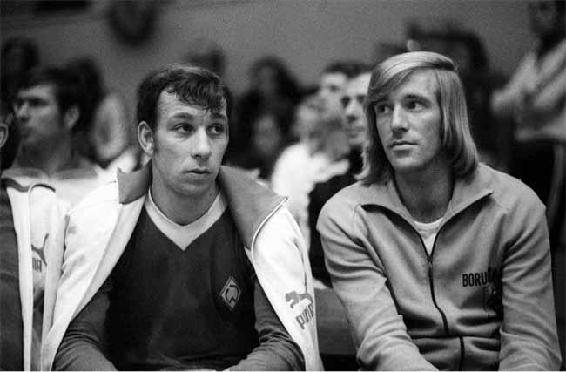
For the 1971/72 season, SV Werder not only changed their shirt colours but set out to become German champions again with an all-star squad. Instead of their traditional green-and-white, the SVW played in "Speckflaggen" kits. The colours of the city of Bremen adorned the shirt; instead of the Werder-W, the Bremen key appeared on the chest of the striped jerseys. With help from the city and Bremen's business community, the club's debts were written off and they received a share of the stadium advertising revenues. And Werder went on a spending spree. Willi Neuberger and Werner "Acker" Weist (from Borussia Dortmund) plus Herbert Laumen (Borussia Mönchengladbach) now wore the Bremen shirt. What few know: Laumen's Gladbach teammate, superstar Günter Netzer, almost signed for Bremen in 1971/72 too. Player and club had already agreed terms when Netzer made it a condition that he be allowed to publish the stadium programme, just as he did in Gladbach. Werder refused — Netzer was not allowed to publish the "Werder-Echo" and initially stayed at Gladbach. The championship venture failed. Werder finished a mere 11th in 1971/72 and were mocked on all sides. The new sponsors withdrew. Crippled by debt, the club stumbled towards the 2. Bundesliga.
Werder in HSV shirts? Impossible? Not quite! Referee legend Walter Eschweiler deemed the kits of northern rivals HSV and Werder Bremen too similar in colour at half-time in Hamburg's Volksparkstadion on November 27, 1971. Since Werder were playing that season in Bremen's city colours of red and white rather than their usual green-and-white, and had no truly distinguishable away kit with them in Hamburg, the consequence was inescapable: Werder had to play the second half of the match — which they lost 1-2 — in HSV shirts. Humiliation doesn't come much worse…
Barely back in the Bundesliga, Werder Bremen suffered their heaviest defeat in the top flight in 1981/82 — still a record to this day. They were thrashed 2-9 (1-4) at Eintracht Frankfurt on matchday 14. „Ronny“ Borchers scored three for the Frankfurt side. Less well known is that a car accident partly contributed to Bremen's heavy defeat. Substitute goalkeeper Hermann Rülander, deputising for regular keeper Dieter Burdenski, had sustained a concussion in a car accident before kick-off and was seeing double. Out of misplaced pride, he told his coach Otto Rehhagel nothing about the injury. A disastrous debut — Rülander never played in the Bundesliga again.
For the Haters
Embarrassing disasters and major defeats
Bremen haters are welcome to frame the Bundesliga statistics from the 1979/80 season.
Relegation 1979/80: Eintracht Braunschweig were relegated in 18th place, and Werder Bremen joined them out of north German solidarity. The 1979/80 season remains historically the worst for Werder Bremen in the Bundesliga. Almost all negative records — as of December 2019 — date from this season, in which neither World Cup runner-up Wolfgang Weber nor coaching veteran Fritz Langner could prevent what remains the club's only relegation. The cringe-worthy records include:
Worst finishing position: 17th in 1979/80, above only Eintracht Braunschweig, was the club's worst-ever top-flight placing. Hertha BSC in 16th also went down to the 2. Liga Nord.
Most goals conceded: In 1979/80, Werder's goalkeeping legend Dieter "Budde" Burdenski had to pick the ball out of the net 93 times.
Heaviest away defeat: On April 12, 1980, they lost 0-7 (0-2) at eventual champions FC Bayern München. Until the return to the Bundesliga in 1981, this was Werder's worst away result, alongside the matchday 26 defeat of the 1963/64 season at Eintracht Frankfurt (also 0-7). Then came the already-mentioned 2-9 at Frankfurt (November 14, 1981).
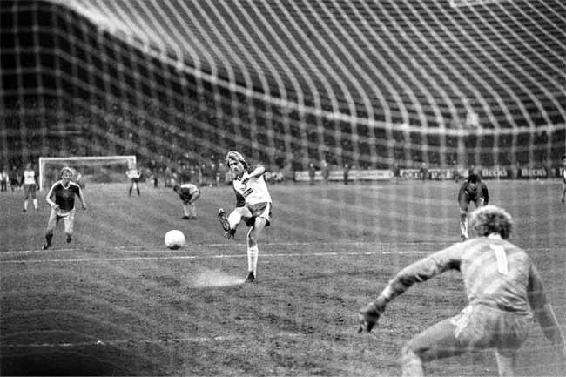
Most defeats: Werder lost 20 matches in the relegation year of 1979/80.
Worst goal difference: -41 in 1979/80, with 93 goals conceded. A lonely record ahead of the 2013/14 and 1974/75 seasons with -24 each.
But some sad records have been set in more recent history too:
Fewest points: The lowest points tally came in 2012/13. Thirty-four points meant safety from relegation wasn't confirmed until matchday 33.
For the Lovers
Key triumphs and major victories
European Cup Winners' Cup: The greatest success in Werder Bremen's history is winning the European Cup Winners' Cup in 1992 under coaching icon Otto Rehhagel. On May 6, 1992, Bremen beat AS Monaco 2-0 (1-0) in Lisbon through goals from Klaus Allofs and Wynton Rufer.
The Double: At least on a par with the club's only European trophy to date — Werder lost the 2009 UEFA Cup final 1-2 after extra time against Shakhtar Donetsk — is the 2004 "Double" of league title and DFB-Pokal for Werder fans. The fact that the title was clinched at rivals Bayern München gave it a special flavour.
"Fish weeks" against HSV: Equally memorable is the 2008/09 season, in which Werder Bremen triumphed over arch-rivals HSV in both the DFB-Pokal and UEFA Cup semi-finals during the unforgettable "Fischwochen."
Werder „rockt“ die 2. Bundesliga Nord: The bitter 1980 relegation was followed by immediate promotion – — with the best record across all divisions since the Bundesliga's inception. Calculated on a three-points-for-a-win basis, they collected 98 points from 42 matches (68 under the old system). On May 12, 1981, a 3-0 (2-0) win at VfB Oldenburg's legendary Donnerschweer Stadion („Die Hölle des Nordens“) die Rückkehr perfekt. Coach Otto Rehhagel's squad was stacked with names — alongside goalkeeper Dieter Burdenski, Schalke legend Klaus Fichtel and Erwin Kostedde took the field in Oldenburg, all former internationals.
One of the best runners-up ever: Werder's best Bundesliga season by points was 1982/83 with 75 points (converted; 52 under the old system). That meant level on points with arch-rivals Hamburger SV, whose goal difference was eight better. Small consolation: Rudi Völler became the first Bremen player to win the top-scorer award.
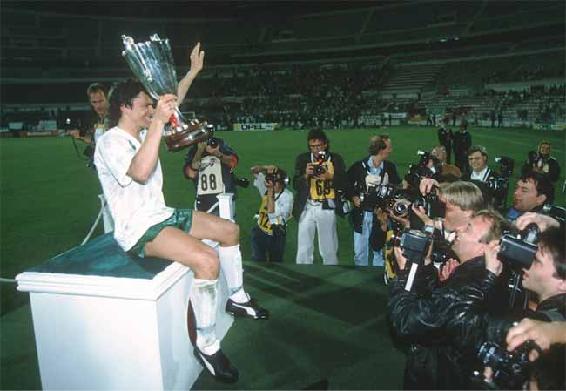
Best goal haul: The Weser's goal machines — Rudi Völler, Frank Neubarth and Uwe Reinders — let rip in 1984/85. Their 87 goals set a Werder Bundesliga record and represented the best attacking output that season. 1. FC Kaiserslautern and Karlsruhe headed home with 1-6 and 1-7 drubbings… Rudi Völler, the undisputed crowd favourite of those years, scored 25. But it was only enough for second place again, with Bayern collecting four more points.
Historic Double: The 2003/04 season — peak Werder! From matchday 16 (after a 3-1 win over Bayer Leverkusen), the team of Werder legend Thomas Schaaf sat top of the table and never relinquished the lead. Six points clear of Bayern München, Werder Bremen were crowned German champions and then clinched the DFB-Pokal with a 3-2 victory over Alemannia Aachen at Berlin's Olympiastadion. In the shadow of top scorer Ailton, Ivan Klasnic emerged as the discovery of the season with 13 goals and 11 assists. At Werder's triumphal coronation on matchday 32 at Bayern (3-1), Klasnic humiliated Munich keeper Oliver Kahn.
Champions — and only table leaders twice! Perhaps the greatest Werder miracle in the Bundesliga! In the 1992/93 season, Bremen were crowned champions having been top of the table on only the final two matchdays! On matchday 4, after a 2-5 drubbing in Karlsruhe, Rehhagel and co. were down in 16th. On the last matchday, a 3-0 win in Stuttgart saw the northerners overtake perennial leaders FC Bayern, who slipped up with a 3-3 on Schalke — sweet revenge for the championship lost on the home straight in 1986.
Biggest home win: Werder Bremen thrashed Kickers Offenbach 8-1 on matchday 15 of the 1983/84 Bundesliga season. They matched the result on matchday 8 of the 2007/08 season, also in the Bundesliga, against Arminia Bielefeld.
Most Important Persons
The men who shaped the club
Came to stay: At first it looked like a brief interlude on the Weser: Otto Rehhagel arrived at SV Werder Bremen on February 29, 1976 as a "firefighter" on a contract until the end of the season. The northerners sat 14th in the Bundesliga on matchday 22 and were threatened by relegation…
The last title-winning coach: With 14 years and one day, Schaaf ranks among the longest-serving coaches without interruption at a single club in German professional football. From May 10, 1999 to May 11, 2013, Schaaf held the reins and led a then-unsettled squad back to the…
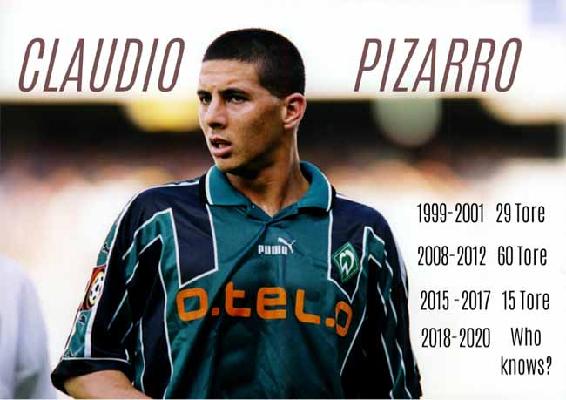
Oldie but goldie: The Peruvian horse lover has always made Bremen fans' hearts beat faster. His first Werder stint lasted from 1999 to 2001 — he scored 29 goals and was bought by Bayern. In 2008, „Piza“ als „Leihgabe” von Chelsea zurück, wird erfolgreichster Torschütze der Bremer und…
The captain: Arnold "Pico" Schütz won the DFB-Pokal with SV Werder Bremen in 1961 and, in the second Bundesliga season (1964/65), the championship as captain. The club legend wore the Werder shirt 826 times from 1955 to 1972. From 1963 to 1972, he played 253 times for Werder…
Das Bremer Triumvirat:Wilfried „Willi“ Lemke war Sonderberater des UN-Generalsekretärs für Sport im Dienst von Frieden und Entwicklung, Senator für Bildung und Wissenschaft und Senator für Inneres und Sport der Freien Hansestadt Bremen. Nach seiner Zeit als Manager von Werder Bremen. Unter der Führu…
Personae Non Gratae
The men fans love to hate
Bedankt:Nur sechs Monate darf der Niederländer die Bremer lenken, bis er vorzeitig verabschiedet wird. Nach dem Scheiden von „Übervater Otto“ präsentiert der Bundesligist am 1. Juli 1995 ambitioniert den neuen Trainer. De Mos sollte weiterführen, was Rehhagel erfolgreich aufgebaut hat. Die Vereinssp…
Der Sprücheklopfer:„Lebenslang Werder – kein Tag Wiesenhof” lautet das Statement des Grünen-Politikers im August 2012. Nachdem Bremen im Geflügelunternehmen Wiesenhof einen neuen Trikotsponsor gewinnen kann, zieht Trittin die Konsequenz und sich als Umwelt-Botschafter des Vereins zurück. Die Firma s…
The unlucky one: The Croatian played for Werder for seven years before deciding against an offered contract extension. The reason: the club doctors. In April 2008, the striker filed a lawsuit against team doctors Götz Dimanski and Manju Guha after they mishandled his deteriorating…
Tragic
Those who suffered misfortune
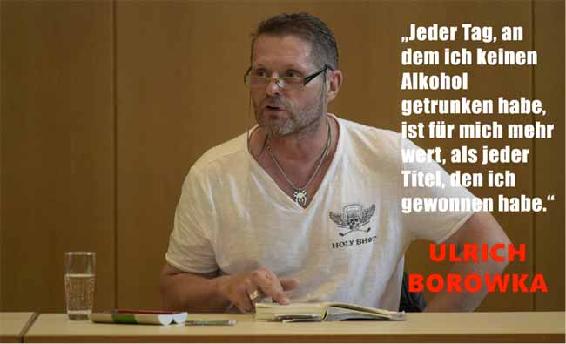
Ulrich Borowka — Iron Foot: "The Axe" made 239 appearances in the Werder shirt. As a defender, the combative Borowka formed the wall in front of the Bremen goal from 1987 to 1995, letting few opponents past and using every means at his disposal. During his Gladbach days in 1984, he greeted opponent Olaf Thon with the words "I'll break both your legs in a minute." Point made, even if the defender never followed through. With Werder, "Iron Foot" Borowka won the German championship in 1988 and 1993 and the DFB-Pokal in 1991 and 1994. His career peaked with the 1992 European Cup Winners' Cup triumph in Lisbon, by which time he was already a full international (six caps in 1988, including the home European Championship). After retirement came the fall: Borowka made headlines with his alcohol dependency and violent outbursts, ended up in a rehab clinic and wrote a book. In it, he admitted he had been an alcoholic even as an active player. Brave! But his past kept catching up with the long-since-sober Borowka. The DFB twice struck him from planned ceremonies honouring former cup heroes, about which he publicly complained in December 2019: "My alcohol addiction was apparently raised again and again in jury meetings. I feel discriminated against by the DFB."
Horst-Dieter Höttges — The trauma of 1966: Höttges played for Borussia Mönchengladbach from 1960 to 1964 and for Werder Bremen from 1964 to 1978 — 420 Bundesliga appearances. As a powerful right-back, he was the "Iron Foot" of Werder's defence and a key figure during the club's first golden era. He won the 1965 championship and 1961 DFB-Pokal. With 66 caps for West Germany, Höttges was a stalwart of the national team. But one match haunted him forever: the 1966 World Cup final at Wembley against England. The controversial third goal — Geoff Hurst's shot that bounced off the crossbar — remains the most debated moment in football history. Höttges was the closest German defender. He maintained until his death that the ball never crossed the line. Höttges died on December 15, 2020 at the age of 77.
Erwin Kostedde — Innocent behind bars: In 219 Bundesliga matches, Erwin Kostedde scored 98 goals. He earned three international caps in 1974 and 1975, becoming Germany's first Black international. He made his debut on December 22, 1974 in Gżira in a 1-0 European Championship qualifier against Malta. His third and final cap came on October 11, 1975 in a 1-1 draw in the European Championship qualifier against Greece. Then-Werder manager Rudi Assauer said of signing Kostedde for Bremen in 1980: "Kostedde doesn't need to run for us anymore — it's enough if he stands in the opposition penalty area and scores goals with his backside." Kostedde delivered, scoring 38 goals in 75 matches for Werder. After retirement, he lost his savings of over one million DM through a dubious investment adviser. In 1990, he was arrested on suspicion of an armed robbery at an amusement arcade in Coesfeld and, after months in custody, acquitted. The police had investigated carelessly; the prosecution witness had mistaken him for someone else. But his reputation was ruined. He received a meagre 3,000 DM compensation for his wrongful imprisonment. "The old Erwin Kostedde died in 1990," Kostedde said of the accusations and the image associated with the crime he never committed. Kostedde is remembered for saying: "I never want to work again — I just want to stand at the bar and drink."
Manfred Burgsmüller — No luck at the end: "Manni" Burgsmüller is the fifth-highest scorer in Bundesliga history, a crafty striker and a sly fox. His misfortune: he never had a role in the national team. In the era of Gerd Müller, he earned just three caps. He scored 213 top-flight goals from 1974 to 1990 for Rot-Weiss Essen, Borussia Dortmund, 1. FC Nürnberg and Werder Bremen. At BVB, it is not Pierre-Emerick Aubameyang, Stéphane Chapuisat or Michael Zorc who hold the club record, but still Burgsmüller with 135 Bundesliga goals. To round off his active sporting career, he played six years of American Football for the Düsseldorf Rhein Fire. As a kicker he made a name for himself and entered the annals as the "oldest player of all time." Burgsmüller was 52 when he ended his American football adventure. The long sporting career left its mark — arthritis. BILD published an initial appeal for solidarity and described his suffering: "Semicircles have formed under his eyes, the bags are swollen. His face is badly bloated, crutches lean against his chair." Burgsmüller died in May 2019 at the age of 69.
OMG — Oh My God
You can't be serious
Lost in Translation — How Werder "steal" from England… "Football's coming home" ("Three Lions on the Shirt")… Every football fan knows this EURO 1996 anthem by Baddiel, Skinner & The Lightning Seeds. Since Bremen take things literally ("Moin, moin, Gascoigne"), the stadium DJs simply translated the song word-for-word into German. But that's not all. Werder also went "English shopping" with a slogan in 2016…
Copycat Werder Bremen: A song regularly played at the Weserstadion since the 2003/04 Double season is "Fußball kommt nach Haus" ("Das W auf dem Trikot") — and instead of "Jules Rimet still gleaming," it goes "Die Meisterschale glänzt noch." Even the Monkees' "Daydream Believer" wasn't safe from the Weser translation artists. In Bremen it sounds like: "Wir sind Werder Bremen" — with all due respect, that's strictly for die-hard fans… as is the slogan "This is Osterdeich," launched in 2016 as the northern German equivalent of the supposedly untouchable "This is Anfield" to motivate the team in the relegation battle.
Werder — cringe moment: The cringe came at the homecoming after the 1992 European Cup Winners' Cup triumph in Lisbon. "And now Otto Rehhagel sets foot on German soil," intoned Werder's house reporter Rolf Töpperwien of ZDF, truly abandoning all restraint as the coaching king arrived with the trophy at Bremen-Neuenland airport.
0-4 in Pasching: The 2003/04 "Double" season also featured one of the greatest footballing embarrassments in Werder Bremen's history. On July 30, 2003, Werder went to the UI Cup semi-final with virtually the same XI that would become German champions and cup winners less than a year later — and were thrashed 0-4 (0-3) by Austrian no-name club SV Superfund Pasching.
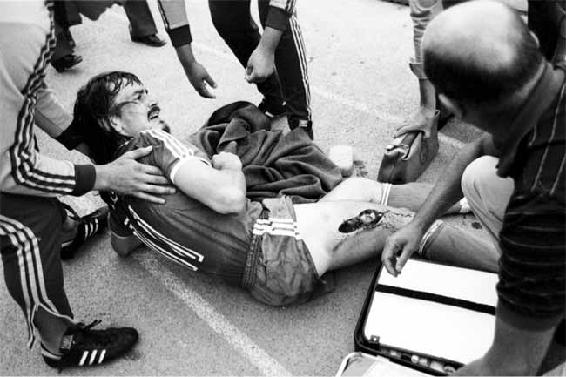
The "Slasher": Bremen's Norbert Siegmann is certainly not remembered for his 1-0 goal in the Bundesliga return against Borussia Mönchengladbach on the opening day of the 1981/82 season. He entered football infamy for one of the most horrifying fouls in Bundesliga history. On August 14, 1981, Siegmann's open studs-up tackle slashed a 25 cm gash in Ewald Lienen's thigh in the match against Arminia Bielefeld — the wound gaped to the bone. The images became the defining sporting horror of the 1980s. Siegmann was banned for ten weeks. The two later reconciled.
Fun Facts
Knowledge for blowhards, braggadocios and connoisseurs
The greatest triumphs and the "Miracles on the Weser" with unforgettable floodlit European nights at the Weserstadion against Anderlecht (5-3 after being 0-3 down, 1993), Dynamo Berlin (5-0, 1988) and Olympique Lyon (4-0, 1999) have long been part of German football history. But Werder is more than just miracles. There are plenty of fun facts about the German champions of 1965, 1988, 1993 and 2004 that will score points against any HSV fan.
Werder? Hamburg has had enough! Bremen against HSV never went well. But when Bremen won the title, there was also a thrashing for the unloved Hamburgers. Andy Herzog and co. swept the "Rothosen" out of the Weserstadion 5-0 on matchday 33 of 1992/93. The mood at Hamburg's Volksparkstadion a week later against Eintracht Frankfurt (1-2) said it all. "We've had enough!" read a lonely fan banner in the empty Westkurve… In 2004, Hamburg suffered a 0-6 defeat in Bremen on matchday 30. In both cases, Bayern were not amused. Karl-Heinz Rummenigge spoke of a "shoddy north German provincial farce" in 1993. Misreading the Hanseatic rivalry, they suspected match-fixing. At least Werder were champions in both years — ahead of FC Bayern.
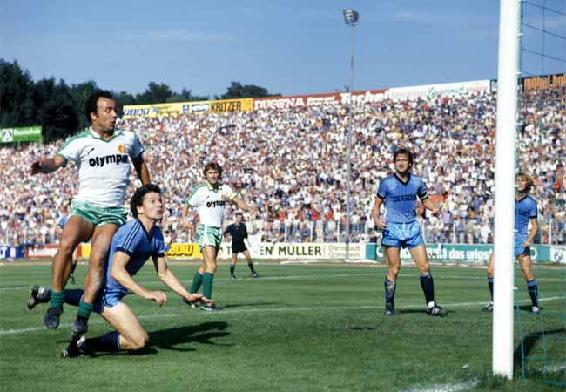
The best throw-in of all time: Bayern had even more reason to be annoyed by Werder. But on August 21, 1982, they only had themselves to blame. Their new goalkeeper Jean-Marie Pfaff, Belgium's number one, made his Bundesliga debut that day and ensured everyone noticed. In the 44th minute, he conceded the first throw-in goal in Bundesliga history. Striker Uwe Reinders, a man with powerful arms and a big mouth, hurled the ball with wind assistance into the six-yard box where it bounced high. Too high for Pfaff, who was also impeded by sweeper Klaus Augenthaler, only getting his fingertips to the ball and letting it bounce into the net. Had he not touched it, the goal would not have counted. Worse still: it was the only goal of the match. Werder celebrated their throw-in goalscorer. And Reinders played it cool: "I wanted to throw the ball to Rudi Völler, who was supposed to flick it into the middle. And then three others were supposed to charge at the ball like bulls. We practised that in training just like other set pieces." Curiously, Werder also benefited from the second and so far last throw-in goal in Bundesliga history. In September 2018, Stuttgart's Ruben Sosa threw the ball towards his own goal, surprising goalkeeper Ron-Robert Zieler, who only got a foot to it. Goal for Werder — though this time it was merely a fun fact in a defeat (1-2).
The year of Freibad-Toni: Ailton is certainly one of the most colourful players Werder Bremen have ever had on their books. The Brazilian, signed from UANL Tigres in Mexico in 1998, claimed the Bundesliga top-scorer cannon in the 2003/04 title season with 28 goals. "Freibad-Toni," as the South American was also known, delivered the best scoring return since Bayern legend Karl-Heinz Rummenigge in 1980/81 (29 goals) and was even named "Footballer of the Year" in 2004. The "Goal of the Month" award went to "Ein Chanc, zwei Tor, das Ailton" three times that season — it doesn't get much better.
Otto und „Assi“ auf Kneipenstühlen: Das Meisterstück in der 2. Liga 1981 in Oldenburg erleben Werder-Coach Otto Rehhagel und Manager Rudi Assauer im engen Stadion am Spielfeldrand auf eigens herbeigeschafften Kneipenstühlen.
Phenomenon "Piza": Born on October 3, 1978, Peruvian professional Claudio Pizarro held three Bundesliga records as of December 2019: most appearances by a foreign player, oldest Bundesliga goalscorer, and Werder Bremen's all-time top scorer.
Werder's goal kings: Only one lifted the shield! Four Werder strikers claimed the Bundesliga top-scorer crown in more than 55 years. With one catch — only Ailton (2004) also won the German title as the league's leading marksman. First was Rudolf "Rudi" Völler in the 1982/83 runners-up season. Next came "Super-Mario" Basler in 1994/95. The explosive Palatinate native was also only runner-up and ultimately had to share the top-scorer title with Heiko Herrlich of Borussia Mönchengladbach (also 20 goals). Third was Miroslav Klose in 2005/06. With 25 goals, the international striker shot Werder to second place behind Bayern.
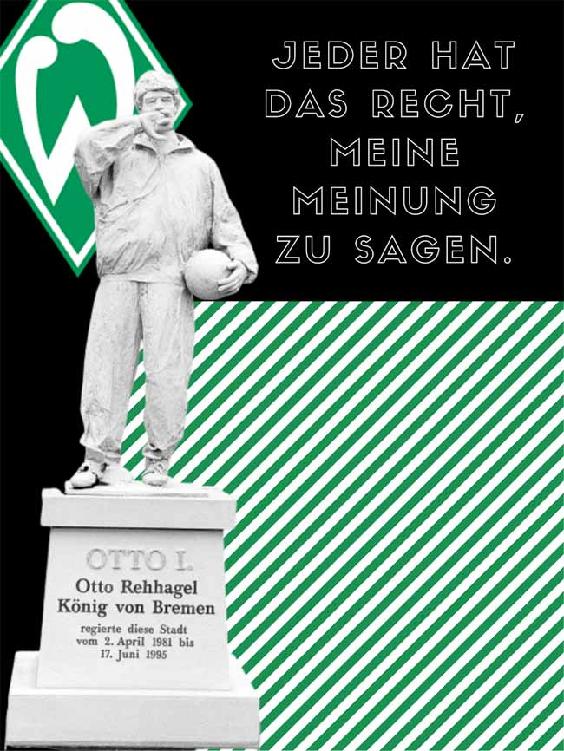
"Otto, I like him": A monument outside the Weserstadion for the greatest successes in club history and the longest-ever reign of a Bundesliga coach to this day — from 1981 to 1995, "King" Otto Rehhagel ruled at Werder Bremen. His squad sang him a somewhat awkward farewell ditty ("Otto… find ich gut").
The European Cup is no place for cowards: "Come out, you cowards, so we can finish you off," Werder striker Manfred Burgsmüller († 2019) banged on the visitors' dressing room door before the 1988 European Cup match against Dynamo Berlin. Werder overran the GDR champions 5-0 after a 0-3 first-leg defeat in Berlin — and it could even have been 6-0. BFC goalkeeper Bodo Rudwaleit scraped a Burgsmüller shot off the line in the first half…
Special Moments
Broken ribs, lacerations, concussion. "Knight Kuno" has to call it quits.
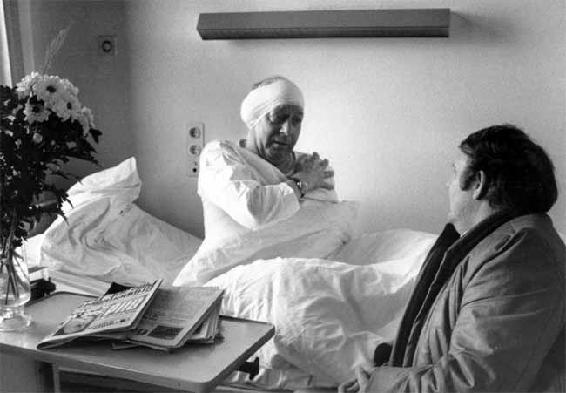
Every football fan felt the shock. On February 8, 1981, the respected fellow coach Kuno Klötzer was seriously injured in a car accident on the B214 between Celle and Braunschweig on an icy road. Broken ribs, lacerations, concussion. "Knight Kuno," as they christened him in Hamburg, was fortunate in his misfortune.
Kuno tried once more to return to the Werder Bremen bench. At nearly 59, he was one of the old guard in this business, this brutal coaching business. How tough life in the Bundesliga coaching guild can be — I experienced that first-hand.
On April 30, 1978, Borussia Dortmund relieved me of my coaching duties after a 0-12 defeat at Borussia Mönchengladbach on the final Bundesliga matchday. The media, where I had often rubbed people the wrong way and whom I had frequently blamed for the fast-paced nature of the football business, were of course not gentle. "Otto Torhagel" was still the mildest name for the greatest disaster any team in Germany's top flight had ever endured — and for which I bore the responsibility. Some particularly clever journalists even suggested I had deliberately lost by such a margin so that Gladbach could still become German champions. Match-fixing and so on. That was nonsense, of course. "The people who wrote that don't dare speak to me anymore. It first appeared in BILD — they were simply looking for a story," was my response to the fierce accusations at the time.
Since voluntarily resigning my coaching post at Arminia Bielefeld in the 2. Liga in October 1979 — with DSC president Jörg Auf der Heyde suggesting I had "lacked self-motivation" and could "only achieve short-term success with teams" — I was even considered virtually unhirable in the business. That is just about the worst thing that can happen to you as a Bundesliga coach. When people no longer believe you can achieve lasting success as a manager, you are the poorest soul in the league.
At Fortuna Düsseldorf I showed everyone what I could do. That I was not merely the "firefighter" raging up and down the touchline like a madman, as the league perceived me. "Rehhagel will calm down eventually," Toni Schumacher prophesied in 1986. My star pupil in Düsseldorf, Klaus Allofs, whom I later brought to Werder Bremen too, confirmed this impressively: "He arrived as the firefighter, the wisecracker, the coach who can save a team but doesn't stay long. He'd been at a few clubs, but didn't yet have the experience. Nevertheless, he was able to set up the team well, to recognise what mattered."
DFB-Pokal winners in 1980 with Fortuna, my first title as a coach. A 0-3 defeat at 1. FC Kaiserslautern in December 1980 and 16th place led to my departure from Düsseldorf, as the club had already secured the services of Heinz Höher. He, like me, had the dubious image of a "firefighter."
Fortunately, Kuno Klötzer was feeling better by February 1981. But he had persistent headaches and could no longer fulfil the coaching role at Werder Bremen on a permanent basis. Werder Bremen's manager Rudi Assauer got in touch. He persuaded me to take over from Klötzer at Werder in the 2. Liga. In the meantime, he had been sitting on the bench himself during Kuno's absence. He had already done that during the 1979/80 relegation season — making announcements that would be unthinkable today. "In that sense, there is a dream coach, the coach who gets us back out from the bottom — that's who I want," Assauer said in January 1980. He brought in 67-year-old coaching veteran Fritz Langner and, to lighten the mood before the away match in Munich, treated the entire squad to schnapps.
You can imagine that this pub-footballer mentality was no use. To Assauer's credit, he stayed after the 1980 relegation, the worst season Werder Bremen had ever had in the Bundesliga. They had conceded 93 goals, eleven of them against champions FC Bayern München alone. "I helped screw this up, I'll fix it too," said Assauer. His boss, anaesthetist Dr. Franz Böhmert, who had been Werder president since 1970, chose more drastic words a year later: "The club was in a coma." "In the 2. Bundesliga," Franz astutely observed, "they train and pay like in primary school." Assauer, however, drew a salary line: "No player earns more than 200,000 marks."
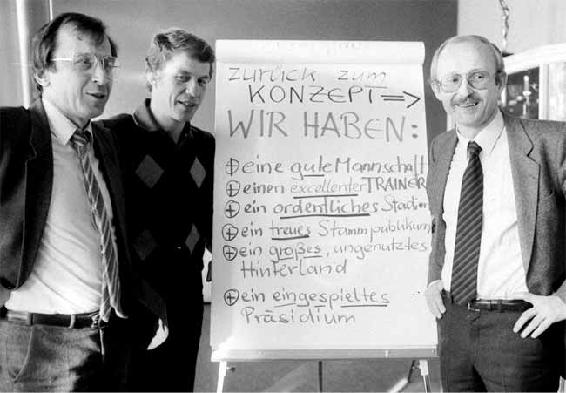
That drove most of the players away. Dieter "Budde" Burdenski was one of the few who stayed. Otherwise, Werder Bremen's 2. Liga squad was met with biting mockery from the media. "The new players almost give Werder fans the feeling that the club is setting up a refuge at the Weserstadion for ageing and left-behind footballers," wrote DER SPIEGEL, "the new sweeper Klaus Fichtel is 35, the new centre-forward Erwin Kostedde is 34." Harsh.
From day one I would prove the opposite with my boys. Erwin Kostedde, who had already been my player at Dortmund and Offenbach and scored more goals under no other coach than during our time together, repaid my trust with nine goals in twelve matches. The comeback as Werder coach ended with a commanding 4-2 win at Union Solingen, also thanks to a Kostedde goal. A 6-0 home win against Alemannia Aachen followed.
A few days later, Kuno Klötzer went to Dr. Franz Böhmert and relinquished the coaching position at Werder Bremen in my favour. It was the decisive moment for me, but also for Böhmert and his SVW — the moment that would turn everything around. Together, we returned to the Bundesliga in commanding fashion in 1981, with the club's best-ever goal tally in professional football of 93 goals scored.
But the three sackings in my coaching career up to that point had made me more cautious. After the 4-2 against Borussia Mönchengladbach on the opening matchday, I declined all congratulations. Many may have interpreted that as typical Otto arrogance, but I stand by what I said at the time: "Football fame lasts only a week." That was no different after our greatest triumphs.
Wise Words
Quotes for eternity
"A football coach must earn so much money for one reason alone: so that in retirement he can afford a first-class room in the madhouse." — Otto Rehhagel, coaching icon of Werder Bremen
"Everyone has the right to voice my opinion." — Otto Rehhagel, coaching icon of Werder Bremen
"Every win feels good, a derby win feels even gooder." — Frank Baumann, Werder Bremen manager
"We're all used to dancing to a woman's tune at home, after all." — Alexander Nouri, former Werder Bremen coach
"Truth is a daughter of time." — Zlatko Junuzovic, former Werder Bremen player
"I'm an optimist. I won't hang myself until all the ropes break." — Otto Rehhagel, coaching icon of Werder Bremen